Imagine if your internet access was as reliable—and as universally expected—as running water or electricity. You wouldn’t worry about overage charges or throttling. You wouldn’t have to move to a city to get fast broadband. You’d simply plug in, and the connection would be there—fair, affordable, and always on.
This idea is not utopian. It’s becoming a practical question for governments, technologists, and economists: Should the internet be a public utility? As more of life moves online—work, education, health, social life—the cost of exclusion rises sharply. Digital access is no longer a luxury; it’s a basic enabler of participation in the modern world.
🧩 What Does It Mean to Call the Internet a Utility?
Designating something as a utility (like water or electricity) implies three things:
-
Public Oversight – Governments regulate access, price, and quality
-
Universal Coverage – Infrastructure must reach rural, low-income, and underserved populations
-
Affordability & Neutrality – No throttling, prioritization, or exclusion
It doesn't necessarily mean the government owns the network—but it means the internet is treated as critical public infrastructure.
⚖️ Why This Debate Matters
As of 2024:
-
Over 2.7 billion people still lack reliable internet access
-
Rural areas in both developing and developed countries remain disconnected
-
Education, jobs, banking, and healthcare increasingly require connectivity
-
Private providers often underinvest where profits are thin
The digital divide is no longer just a gap—it’s a chasm that determines life opportunities.
🏛️ Who's Moving Toward Utility Models?
-
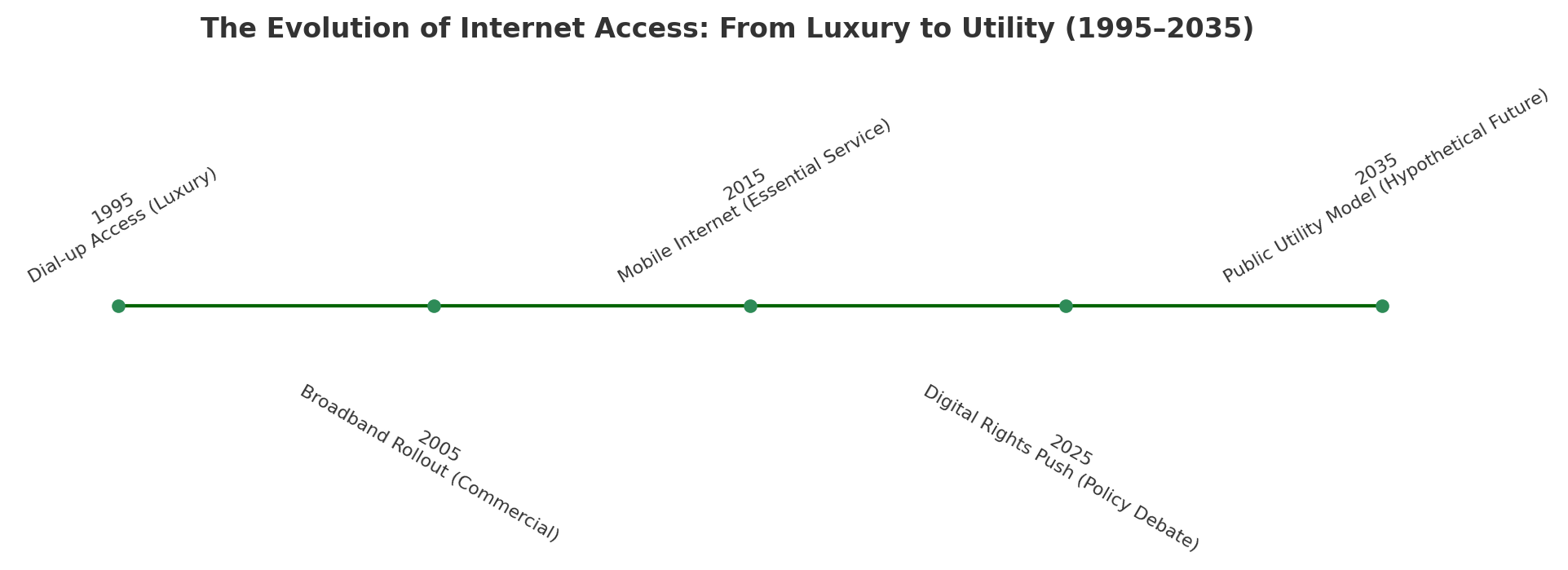
Finland & Estonia: Declared broadband a legal right
-
New York City: Expanded public fiber + municipal Wi-Fi projects
-
India (BharatNet): Ambitious rural fiber rollout, state-managed
-
EU & UN: Pushing for “Internet as Human Right” frameworks
-
Africa & LATAM: Community mesh networks and public infrastructure experiments
🛠️ Pros and Cons of Utility Internet
| ✅ Pros | ⚠️ Challenges |
|---|---|
| Equity & inclusion | Regulatory complexity |
| Lower costs for consumers | Resistance from telecom giants |
| Neutrality and data privacy | Funding public infrastructure |
| Boosts remote work & digital GDP | Government overreach concerns |
🔮 The Road Ahead
If the internet becomes a utility, we’ll likely see hybrid models:
-
Public-private partnerships to expand access
-
Tax incentives for rural fiber
-
Universal basic connectivity included in urban planning
-
Legal protections for net neutrality and access affordability
As Web3, metaverse, and AI-driven infrastructure evolve, seamless connectivity won’t just be helpful—it will be foundational to participating in society.
🧾 Conclusion: Connectivity as a Civic Right
What was once a tool of convenience is now a tool of citizenship. The question isn’t whether internet should be everywhere—it already is. The real question is: Who gets to access it, under what conditions, and at what cost?
Treating the internet as a utility won’t solve every problem—but it could be a turning point for digital equality, economic growth, and technological democracy.
📰 Recent Developments & Trends
-
In 2024, the U.S. Federal Communications Commission (FCC) reclassified broadband as a Title II telecommunications service (i.e. as more utility-like), giving it more regulatory authority (e.g. over traffic prioritization)
-
But in early 2025, a federal appeals court (the Sixth Circuit) struck down that reclassification, arguing broadband must remain an “information service” under existing law
-
Meanwhile, the U.S. Supreme Court recently upheld the constitutional basis for the Universal Service Fund (USF), which helps subsidize telecom and broadband access in rural and low-income areas — a win for policies that treat connectivity as socially essential
-
Congress is also pushing new oversight. The Senate passed the Rural Broadband Protection Act of 2025, requiring ISPs seeking federal funds to demonstrate financial stability
-
On the ground, states and municipalities are making moves:
• New York State awarded $52.6 million to expand broadband, connecting ~6,900 locations and building out fiber and wireless hubs
• However, municipal broadband still faces legal restrictions in ~16 U.S. states, where laws block or hamper local governments from offering their own internet service
• In New York City, the state’s new Affordable Broadband Act (which mandates ISPs offer $15/month and $20/month plans for low-income households) led AT&T to stop offering its 5G home service in the state rather than comply with the price controls -
Internationally, the EU is pushing forward with the Gigabit Infrastructure Act, aimed at lowering deployment costs and accelerating gigabit-speed coverage across Europe — part of a broader push to treat high-speed internet as fundamental infrastructure rather than optional service
-
Globally, the “State of Broadband 2025” report notes that while mobile broadband access has improved, fixed broadband still exhibits serious gaps — especially in rural, remote, or low-income regions, reinforcing that the challenge of universal infrastructure is not solved
🗣️ My Take (as “author voice”)
I believe the momentum toward treating the internet as a utility is inevitable — though fraught with political and legal friction. Here’s how I see it unfolding:
-
The digital divide is no longer hypothetical — denying affordable, reliable access excludes people from jobs, education, healthcare, civic life. In that sense, internet access is part of modern citizenship.
-
But trying to shoehorn existing corporate ISPs into strict utility roles is messy. Many providers will resist, may pull out (as AT&T did in NY), or lobby aggressively to limit regulation.
-
The legislative and judicial tug-of-war (like the Sixth Circuit decision) shows that treating the internet as a utility requires new, clear statutory authority — not just regulatory reclassification.
-
Municipal, cooperative, or community broadband models are where I see the most promise: local control, mission over profit, and flexibility to prioritize underserved areas. But they must be protected from state-level bans or preemptive laws.
-
Hybrid models — public infrastructure + private operations under regulated rules — seem most realistic. The public sector could build “fiber highways” while multiple service providers compete on that backbone under open, neutral rules.
-
We must also worry about sustainability (ongoing funding, maintenance), governance (who sets rules, oversight), and innovation (ensuring regulation doesn’t stifle new services).
In short: the idea of “just plug in, always-on access” is no longer utopian — it’s becoming a political and technical battleground. I’m optimistic that over the next decade we’ll see meaningful shifts toward utility-level internet, but I’m cautious: the path will be uneven, contested, and messy.
✅ Conclusion
The argument for treating internet access as a public utility is gaining traction — backed by new regulatory, judicial, and infrastructure moves — but the transition is far from settled. If done thoughtfully, it could reshape digital equity and civic infrastructure for generations.