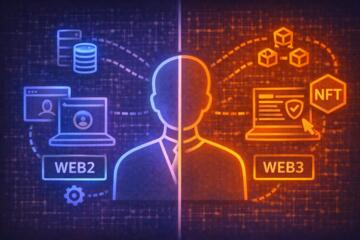
In an era where nearly every action—from unlocking your phone to walking past a surveillance camera—leaves a digital trace, the notion of privacy is being redefined. We live in a hyperconnected world, where smartphones, smart homes, wearable devices, social platforms, and algorithms continuously collect, analyze, and monetize our personal data. While this connectivity enables convenience and personalization, it also comes at a cost: our digital privacy is under constant pressure.
Governments, corporations, hackers, and even AI models can now access and analyze data at an unprecedented scale. Every click, scroll, and spoken word can be tracked, recorded, and turned into a behavioral profile. Digital privacy is no longer just a cybersecurity issue—it's a fundamental part of freedom, safety, and autonomy in the 21st century.
So where are we heading? Will the Internet of the future empower users with control over their data, or will privacy become a relic of the past? Let’s explore the trends shaping this conversation—and the technological, legal, and ethical battles now underway.
📜 A Brief Timeline of Digital Privacy
Here's how we got here:
-
1990s – The early web is anonymous by default; few laws govern data collection.
-
2000s – Search engines and social networks rise. Data tracking becomes more sophisticated.
-
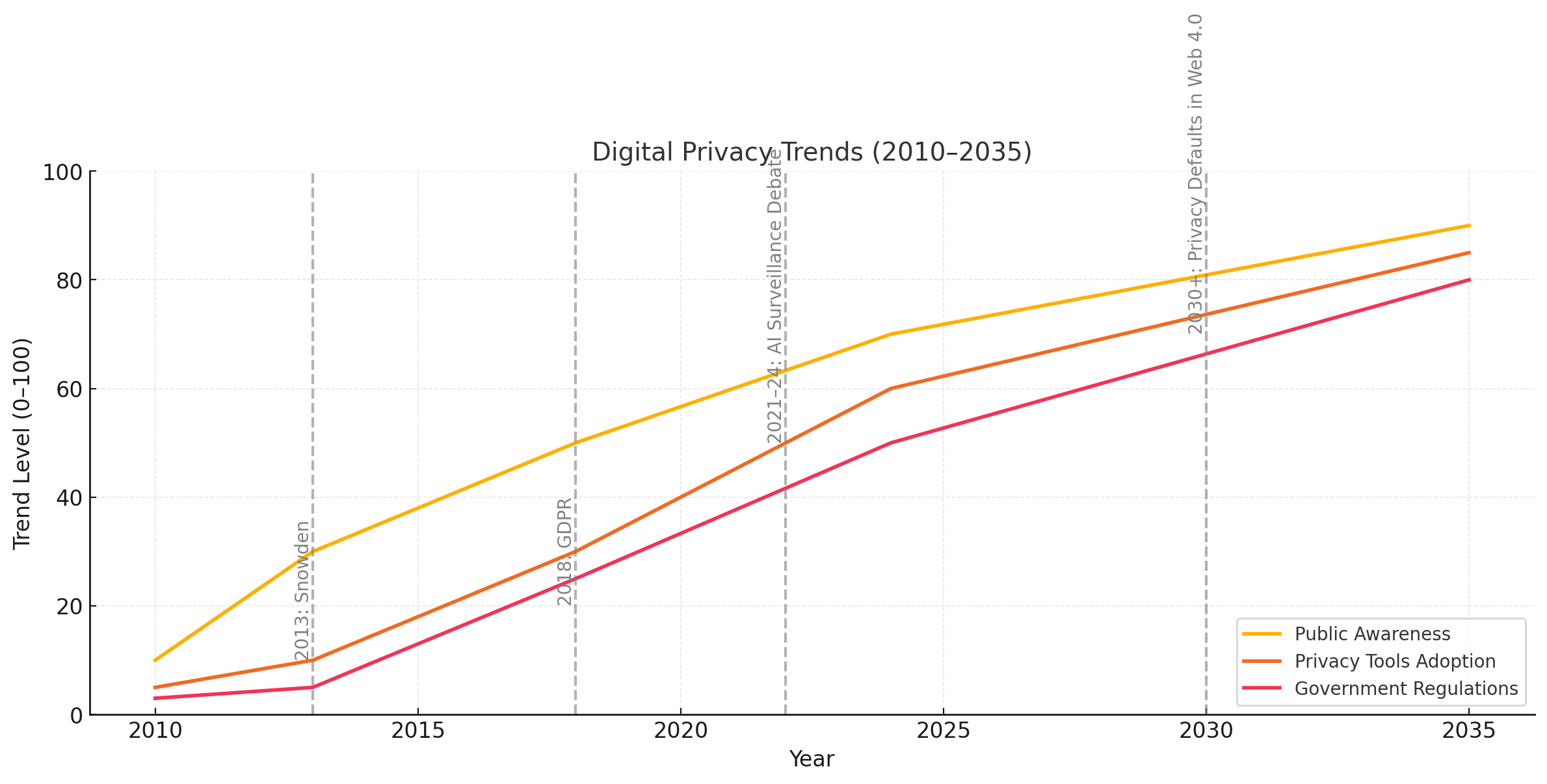
2010s – Smartphones, cookies, and cloud services make data collection ubiquitous. Snowden leaks reveal mass surveillance.
-
2020s – AI, facial recognition, smart devices, and always-on sensors redefine the scale and scope of surveillance. GDPR and other laws push back.
🧠 Understanding Modern Digital Surveillance
Today, data is collected through multiple channels:
-
Smartphones track location, contacts, messages, and behavior.
-
Web activity is monitored through cookies, trackers, and pixels.
-
Social media analyzes posts, clicks, and even time spent reading.
-
Wearables like smartwatches track health, movement, and sleep.
-
IoT devices in your home can listen, watch, and report.
🔥 Trends Shaping the Future of Digital Privacy
1. Decentralized Identity and Data Ownership
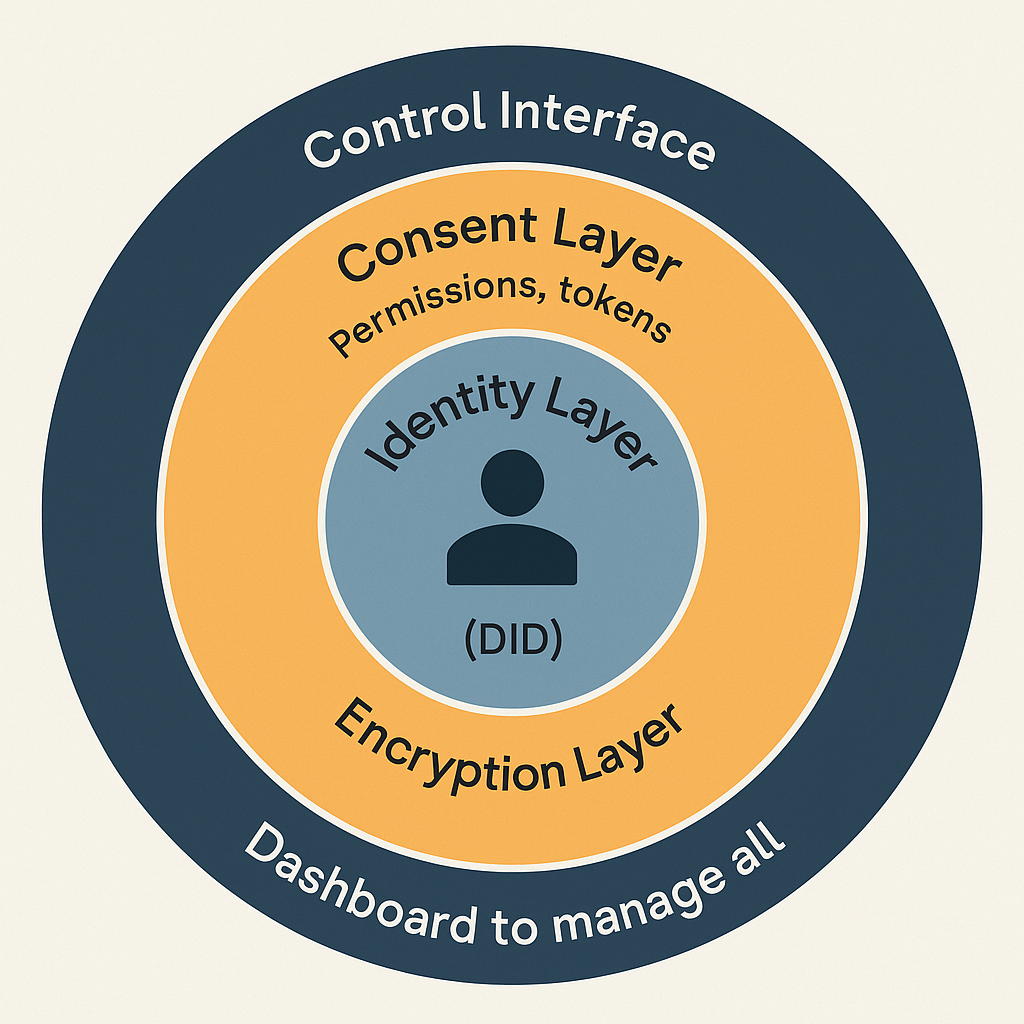
New technologies like DIDs (Decentralized Identifiers) allow users to control their identity without depending on tech giants. Instead of logging in via Google or Facebook, you authenticate using your own encrypted credentials stored in digital wallets.
2. Privacy-First Apps and Ecosystems
Alternatives to mainstream platforms are gaining traction:
-
Brave (browser) blocks trackers by default.
-
Signal (messaging) offers end-to-end encryption with minimal data retention.
-
ProtonMail and Tutanota offer secure email services.
These tools prioritize user privacy over ad revenue.
3. Zero-Knowledge Proofs and Homomorphic Encryption
Advanced cryptographic techniques allow data to be verified or processed without being exposed. For example, you can prove you're over 18 without revealing your birthday.
4. AI-Powered Surveillance
Unfortunately, the same AI tools that protect privacy can also violate it. Governments and companies use facial recognition, predictive profiling, and sentiment analysis to track behavior—sometimes without consent.
⚖️ Legal and Ethical Battles
-
GDPR (EU) and CCPA (California) have forced companies to rethink data collection, but enforcement remains inconsistent.
-
Countries like China and Russia enforce state surveillance, while others try to build privacy-by-design ecosystems.
-
Ethical debates center around consent, algorithmic bias, and digital human rights.
📊 Visual: Privacy Awareness Growth (2010–2035)
🏗️ The Future of Privacy: What Will Change?
By 2035, we may live in a world where:
-
Privacy is programmable: You define exactly who can access your data, for how long, and for what purpose.
-
Digital rights are enforceable: Violating privacy could result in legal or automated economic penalties.
-
AI works for you, not against you: Personal AIs (guardians) help you manage data, detect risks, and negotiate with services.
-
Data becomes an asset class: You might lease your data—securely and anonymously—in exchange for tokens, discounts, or services.
🧱 Visual Concept: Privacy Control Layers
✅ Final Thoughts
In a hyperconnected world, digital privacy isn’t just a personal preference—it’s a necessity. As more aspects of our lives shift online, from banking and healthcare to education and intimacy, maintaining control over our data becomes a matter of empowerment.
We are at a turning point: either we design systems that protect individuals, or we risk building a digital future where surveillance is normalized, and privacy becomes extinct. The tools, laws, and technologies to protect ourselves are emerging—but they need public support, awareness, and intentional use.
The battle for digital privacy is not over. It’s just beginning—and you are part of it.