Microlearning: The Future of Skill Development

3 min read

1

What Is Microlearning?

Microlearning is the process of delivering content in small, focused bursts—usually 2 to 10 minutes—designed to meet specific learning objectives. It leverages multimedia formats such as videos, quizzes, infographics, or interactive modules and often integrates seamlessly into daily workflows.
Key Traits of Microlearning:

  • Short and specific

  • Just-in-time delivery

  • Mobile-friendly

  • Self-paced and flexible

  • Often gamified or interactive

Why Is Microlearning Emerging Now?

Two major forces converge to drive the rise of microlearning:

1. Technological Acceleration

  • Mobile ubiquity: Over 6.8 billion smartphones globally make bite-sized content instantly accessible.

  • AI and adaptive learning: Algorithms tailor content to learners’ pace and preferences.

  • AR/VR/XR: Immersive micro-scenarios simulate real-world problem-solving in medicine, engineering, and customer service.

2. Cultural and Societal Shifts

  • Shorter attention spans: Studies suggest average attention spans have dropped from 12 seconds (2000) to 8 seconds (2023).

  • Gig economy & freelance work: Workers now stitch together skills across diverse domains without long-form degrees.

  • Lifelong learning imperative: Traditional education becomes obsolete faster than ever; adaptability is the new currency.

From Industrial Age to Information Age Learning

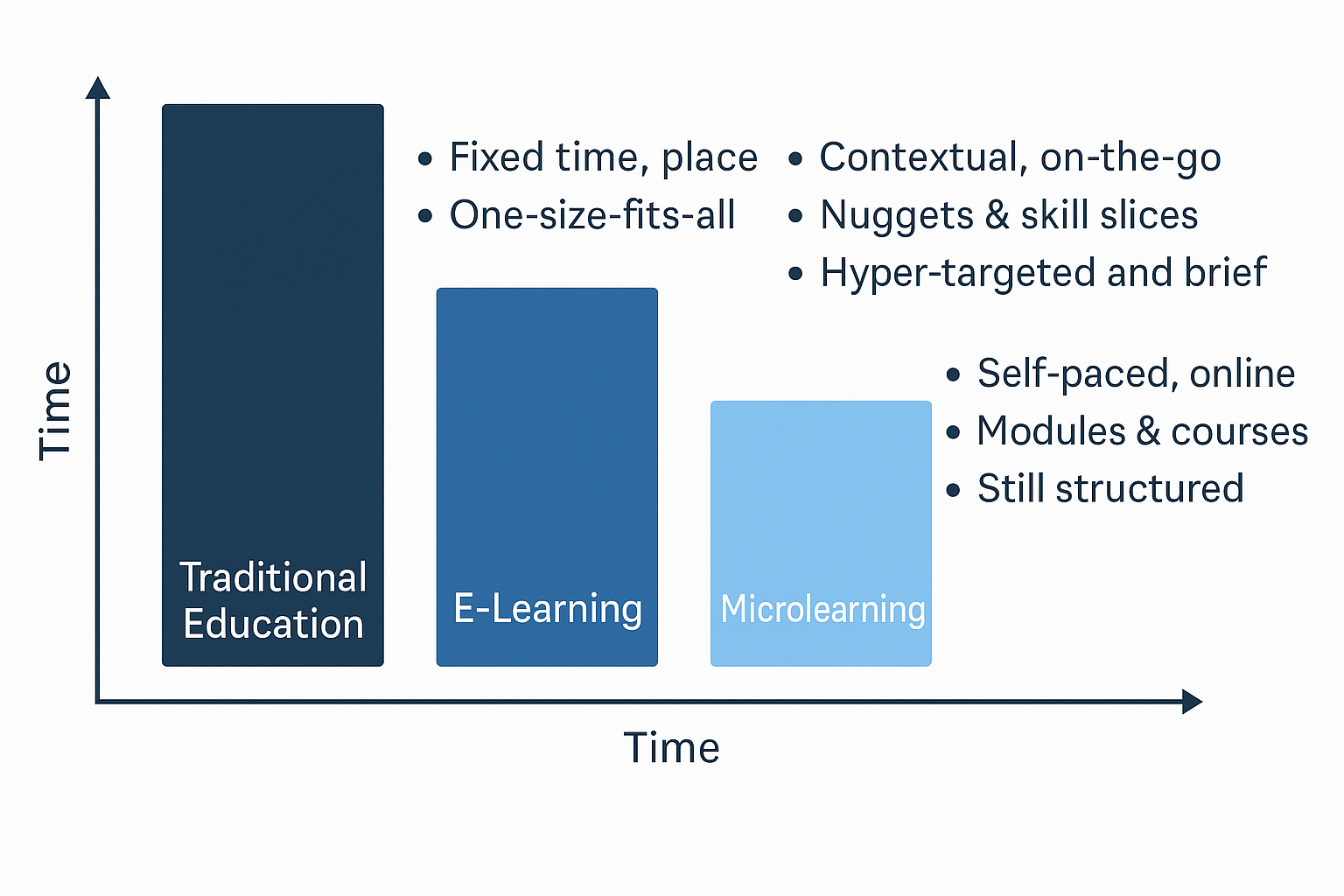
Let’s compare how educational paradigms have evolved:

Traditional Education → E-Learning → Microlearning

• Fixed time, place     • Self-paced, online     • Contextual, on-the-go
• One-size-fits-all     • Modules & courses      • Nuggets & skill slices
• Instructor-led        • Still structured        • Hyper-targeted and brief
• Long completion time  • Weeks or months         • Minutes per topic
 

Microlearning breaks the inertia of traditional education by offering agile learning loops instead of prolonged academic marathons.

Real-World Use Cases

📱 Corporate Upskilling:

Amazon trains warehouse staff in safety procedures via microlearning apps that include quick simulations and scenario-based quizzes.

đź‘©‍⚕️ Healthcare:

Doctors use 5-minute clinical refreshers via platforms like Osmosis or Figure 1 during rounds.

đź§  Language Learning:

Duolingo’s gamified, 3-minute lessons drive user retention by fitting learning into everyday life—between subway stops or coffee breaks.

⚙️ Tech Skills:

Developers use microlearning portals like Frontend Mentor or Scrimba to sharpen specific frameworks without enrolling in multi-week courses.

Strengths and Limitations

Advantages:

  • Highly scalable

  • Boosts retention via spaced repetition

  • Fits modern attention habits

  • Encourages proactive learning

  • Lowers entry barriers to complex topics

Challenges:

  • Risk of oversimplification

  • Limited depth without complementary formats

  • Requires strong content design to be effective

Where Microlearning Meets the Future

Trends to Watch:

  • AI tutors & chatbots: Personal AI companions that nudge, quiz, and summarize content in real time.

  • Neuroadaptive platforms: Wearables + AI = content that adapts to brain state (focus, fatigue).

  • Learning in the flow of work: Seamless integration into Slack, MS Teams, or AR glasses.

Societal Implications:

  • Redefinition of credentials: Micro-certifications and digital badges rival degrees for job-readiness.

  • Closing access gaps: Anyone with a phone can now upskill—whether in Nairobi or Nashville.

  • Rise of polymaths: Learners stack diverse micro-skills to become cross-disciplinary problem-solvers.

Final Thoughts

Microlearning is not just a learning format—it is a cultural response to the velocity of change. In a world where knowledge has a half-life, we must move from the accumulation of knowledge to the renewal of it. By delivering meaningful learning in moments, microlearning meets us where we are—busy, mobile, and perpetually adapting.

It’s not the future of learning because it’s short. It’s the future because it’s smart.

Latest Articles

Education Without Degrees: Are Credentials Still Relevant?

Traditional degrees are no longer the only path to career success. This in-depth guide explores education without degrees, the rise of alternative credentials, skills-based hiring, and online learning platforms. Learn when academic credentials still matter, where they fall short, and how professionals can build credible career paths through portfolios, real-world projects, and verifiable skills. With real company examples, data-driven insights, and practical recommendations, this article helps learners and employers navigate the future of education and workforce development.

The Future of Education

Read » 0

Adaptive Learning Systems: Personalized Education

In a traditional classroom, thirty students may receive the same lesson—but absorb it in thirty different ways. Some excel, some struggle, some disengage. This mismatch between teaching methods and learning diversity has long been a weakness of standardized education. But today, thanks to adaptive learning systems powered by artificial intelligence, we’re entering an era where education learns from the learner. These systems use real-time data to tailor content, pace, and feedback to individual needs—turning every lesson into a personalized experience. This evolution isn’t just technical—it’s philosophical. Education is shifting from a static delivery model to a dynamic, student-centered dialogue.

The Future of Education

Read » 0

Microlearning and the Future of Skill Acquisition

Microlearning is transforming skill acquisition by replacing long, linear courses with focused, task-based learning units that fit modern work schedules. This expert guide explains how microlearning works, where organizations misuse it, and how to design effective microlearning strategies that improve retention, performance, and ROI. With real examples from platforms like LinkedIn Learning, Axonify, EdApp, and enterprise case studies, the article provides practical recommendations for educators, L&D leaders, and organizations building future-ready skills.

The Future of Education

Read » 0

The Rise of Lifelong Learning in the AI Economy

The AI economy is accelerating the shift toward lifelong learning as skills evolve faster than traditional education can keep up. This expert article explores why continuous learning is now essential, where individuals and organizations fail, and how to build effective lifelong learning strategies. Featuring real examples from companies like Amazon and IBM and platforms such as Coursera and edX, it provides practical guidance for professionals, educators, and leaders navigating reskilling, upskilling, and long-term employability in an AI-driven world.

The Future of Education

Read » 0

How AI Tutors Are Personalizing Education

AI tutors are changing how education adapts to individual learners by personalizing content, pace, and feedback in real time. This expert guide explains how AI tutoring systems work, the technologies behind adaptive learning, and why many personalization efforts fail in practice. Learn from real platforms like Duolingo, Khan Academy, Coursera, and Carnegie Learning, with concrete data, case studies, and implementation strategies. Designed for educators, edtech founders, and decision-makers seeking scalable, evidence-based personalized education.

The Future of Education

Read » 0

Microlearning: The Future of Skill Development

In an age where technological progress outpaces traditional education and attention spans are shrinking, microlearning emerges not as a buzzword, but as a necessity. From corporate training rooms to mobile learning apps, it reflects a seismic shift in how we acquire and retain knowledge. As industries race to reskill their workforce amidst automation and digital transformation, microlearning offers a nimble, personalized, and time-efficient approach. This evolution is not merely educational—it’s societal, altering how we define expertise, adapt to change, and democratize access to knowledge in a hyperconnected world.

The Future of Education

Read » 1