Summary
For decades, academic degrees were the primary gateway to skilled jobs and career growth. Today, rapid technological change, online learning platforms, and skills-based hiring are challenging that model. This article examines whether traditional credentials still matter, where they fail, and how alternative education pathways are reshaping hiring, careers, and lifelong learning.
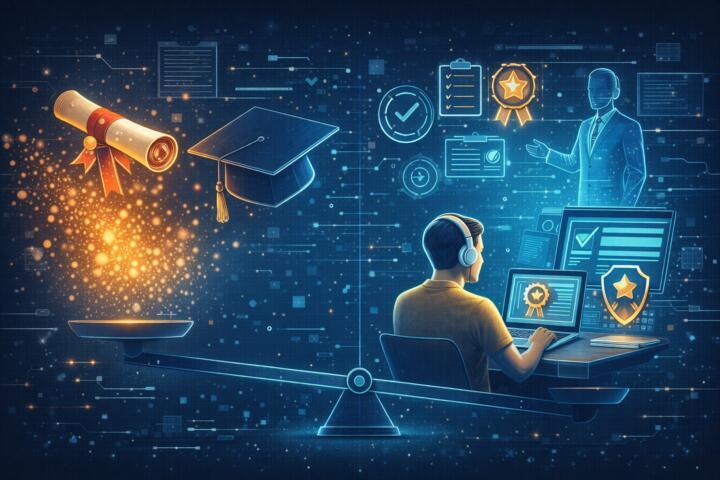
Overview: Why Degrees Are Being Questioned
A university degree once served as a reliable signal of knowledge, discipline, and employability. That signal is weakening.
Employers increasingly struggle to match formal education with real-world skills. According to surveys cited by the World Economic Forum, over 50% of global workers will require significant reskilling by 2030, while degree programs often update curricula too slowly.
In practice, many high-demand roles—data analysis, UX design, cloud engineering, digital marketing—change faster than academic programs can adapt. As a result, alternative credentials and skills-based assessments are gaining traction.
The Shift From Degrees to Skills
Education is moving from time-based validation to capability-based proof.
Instead of asking where did you study?, employers increasingly ask:
-
What can you build?
-
What problems have you solved?
-
Can you demonstrate impact?
Companies like Google and IBM publicly removed degree requirements for many technical and non-technical roles, focusing instead on demonstrable skills and assessments.
This shift does not eliminate credentials—it redefines them.
Pain Points: What Goes Wrong Without Degrees
1. Skills Without Signal
Self-taught learners often struggle to communicate credibility.
Why it matters:
Hiring managers still need reliable filters.
Consequence:
Strong candidates get overlooked due to weak signaling.
2. Credential Inflation
Micro-credentials flood the market.
Platforms issue certificates with vastly different rigor, making it hard to distinguish quality.
3. Lack of Structure
Without formal programs, learners may miss foundational knowledge.
This leads to shallow expertise that fails under complex real-world conditions.
4. Employer Skepticism
Not all organizations are ready for skills-first hiring.
Highly regulated industries—healthcare, law, civil engineering—still rely heavily on formal accreditation.
Solutions and Practical Recommendations
Build Verifiable Skill Proof
What to do:
Create portfolios, public projects, and measurable outcomes.
Why it works:
Concrete evidence outperforms abstract credentials.
In practice:
GitHub repositories, case studies, and real client results replace transcripts.
Use Trusted Credential Platforms
What to do:
Choose programs aligned with industry needs.
Platforms like Coursera partner directly with employers and universities to ensure relevance.
Combine Learning With Work
What to do:
Pursue apprenticeships, internships, or freelance projects.
Why it works:
Real-world context accelerates learning and builds credibility.
Employers: Redesign Hiring Filters
What to do:
Replace degree filters with skills assessments.
Why it works:
Reduces talent shortages and improves diversity.
Result:
Organizations report faster hiring and stronger performance alignment.
Mini-Case Examples
Case 1: Tech Hiring Without Degrees
Company: Global cloud services provider
Problem: Shortage of cloud engineers
Action:
-
removed degree requirements,
-
introduced hands-on technical assessments.
Result:
Expanded talent pool and reduced time-to-hire.
Case 2: Career Switcher Success
Profile: Mid-career professional transitioning into data analytics
Approach:
-
completed targeted online courses,
-
built real dashboards using open datasets.
Result:
Secured a junior analyst role without a formal degree in the field.
Comparison Table: Degrees vs. Alternative Credentials
| Factor | Traditional Degrees | Alternative Credentials |
|---|---|---|
| Time to complete | 3–5 years | Weeks to months |
| Cost | High | Low to moderate |
| Update speed | Slow | Fast |
| Skill specificity | Broad | Targeted |
| Employer acceptance | High (traditional fields) | Growing |
Common Mistakes (and How to Avoid Them)
Mistake: Collecting certificates without application
Fix: Build projects tied to real problems
Mistake: Ignoring fundamentals
Fix: Study core concepts, not just tools
Mistake: Overestimating platform reputation
Fix: Validate learning outcomes with employers
Mistake: Assuming degrees are obsolete everywhere
Fix: Understand industry-specific requirements
FAQ
Q1: Are degrees becoming useless?
No. They remain essential in many regulated and research-driven fields.
Q2: Do employers trust online certificates?
Only when combined with demonstrated skills.
Q3: Can you build a career without a degree?
Yes, in many fields—especially technology and digital roles.
Q4: Are micro-credentials enough for senior roles?
Not alone. Experience and impact matter more at senior levels.
Q5: Will degrees disappear completely?
Unlikely. Their role will change, not vanish.
Author’s Insight
From working with hiring managers and professionals across tech and education, the pattern is clear: credentials still matter, but only when they correlate with capability. The future belongs to hybrid models—structured learning combined with continuous skill validation. Degrees will survive, but they will no longer be the sole gatekeepers of opportunity.
Conclusion
Education without degrees is not about rejecting formal learning—it is about redefining how knowledge is validated. As industries evolve faster than academic systems, skills-based education and alternative credentials will continue to grow. Individuals who combine structured learning, real-world application, and credible proof of skill will remain competitive regardless of traditional credentials.