In a traditional classroom, thirty students may receive the same lesson—but absorb it in thirty different ways. Some excel, some struggle, some disengage. This mismatch between teaching methods and learning diversity has long been a weakness of standardized education. But today, thanks to adaptive learning systems powered by artificial intelligence, we’re entering an era where education learns from the learner.
These systems use real-time data to tailor content, pace, and feedback to individual needs—turning every lesson into a personalized experience. This evolution isn’t just technical—it’s philosophical. Education is shifting from a static delivery model to a dynamic, student-centered dialogue.
🔍 What Are Adaptive Learning Systems?
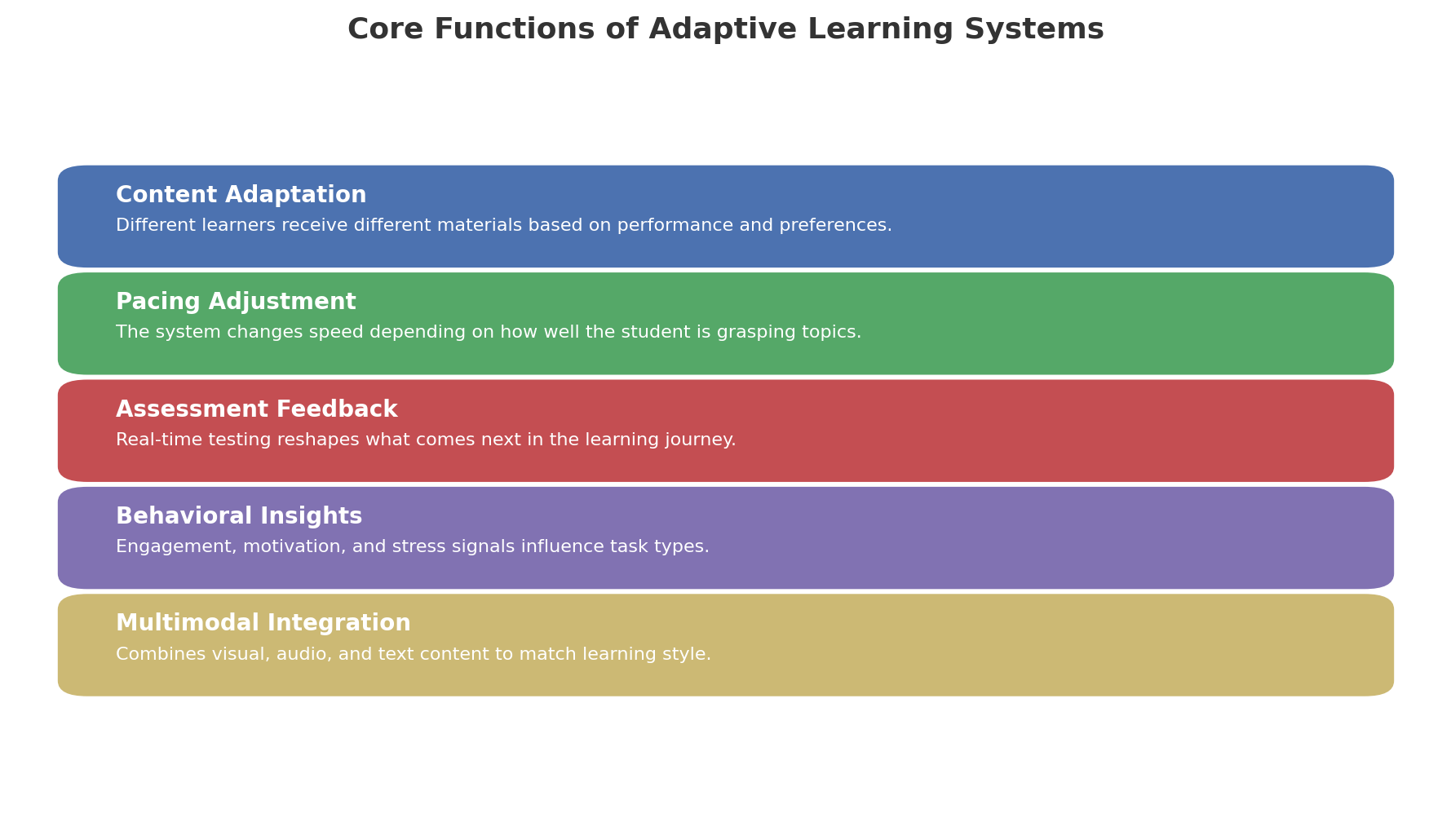
Adaptive learning systems are educational platforms that analyze learner behavior and performance to customize the learning journey. They continuously adjust:
-
What is taught
-
How it’s presented
-
When and how fast it’s delivered
Unlike traditional digital courses, adaptive systems use machine learning to predict difficulties, reinforce strengths, and remediate gaps, often in real time.
🚀 Real-World Examples
-
Knewton uses algorithms to adjust math problem sets depending on student mastery
-
Duolingo adapts language practice frequency and difficulty based on error patterns
-
Smart Sparrow tailors science instruction with embedded diagnostics for medical students
-
DreamBox Learning analyzes click behavior and pacing to adjust math content for K–8 learners
These systems are not just automating education, they’re personalizing cognition.
⚖️ Ethical Dilemmas and Challenges
While promising, adaptive learning systems raise complex questions:
🧠 Data Privacy
-
What kind of cognitive, emotional, or biometric data should systems collect?
-
Who owns this data—students, schools, or platforms?
📈 Algorithmic Bias
-
Could adaptive tools reinforce stereotypes or under-challenge certain groups?
-
How transparent are the systems in how they score and guide?
💵 Access and Equity
-
Will elite schools get better AI tutors, creating a “personalization divide”?
-
Can under-resourced schools afford quality adaptive platforms?
📅 What’s Next?
Adaptive learning is moving toward more holistic personalization:
-
Cognitive models that adjust for attention span, memory strength, and learning disabilities
-
Emotion-aware interfaces that detect frustration or confidence using facial expression or voice
-
Cross-platform learning, where progress in one domain (e.g. reading) influences support in others (e.g. history)
Ultimately, we may see AI companions that evolve with a student over a lifetime—much like a favorite teacher that never forgets how you learn.
🧾 Conclusion: Not Just Smarter Learning, But Wiser Teaching
Adaptive learning is not about replacing teachers—but empowering them. By offloading the data analysis and content personalization, these systems allow educators to focus on what they do best: motivating, mentoring, and meaning-making.
The future of education won’t be shaped by content alone—but by how content shapes itself around us.
📰 Recent Developments & My Perspective
Here are some of the most significant news, research, and shifts in the adaptive learning / AI in education space (2025), plus my personal reflections as someone watching this field.
📈 Recent Developments & Research
-
A new research paper introduces NeuroChat, a “neuroadaptive AI tutor” that uses EEG-based measurement of engagement to dynamically adjust pacing, style, and difficulty. Early results suggest higher engagement, though learning improvements weren’t immediate.
-
Another recent study presents a Human-in-the-Loop (HITL) approach for adaptive learning: students tag or critique AI responses, which then influence further content generation. This method reportedly improved outcomes in STEM settings compared to “vanilla” AI tutoring.
-
The K-12 research nonprofit Foundry10 released new work evaluating the impacts of adaptive learning technologies (ALTs) in primary and secondary settings, adding nuance to how such systems perform in real classrooms.
-
At the AIED 2025 conference, a recurring theme was “AI as a Catalyst for Inclusive, Personalized, and Ethical Education” — reflecting a growing consensus that equity and accountability must be baked into adaptive systems.
-
In policy and funding moves, major organizations (including U.S. agencies) are rolling out AI-enabled curricula and assessment tools across hundreds of courses, accelerating adoption in formal education.
-
On the industry side, Pearson announced a multi-year partnership with Google Cloud to embed AI learning tools (adaptive, analytic, feedback systems) into primary and secondary education globally.
-
In real-world schooling experiments, a private “AI school” called Alpha School opened a new campus in Virginia, where adaptive software handles core academics and “guides” (not licensed traditional teachers) mentor students. Critics warn about unproven models and exclusivity.
-
In India, adaptive learning platforms built in regional languages are being deployed to close language and equity gaps in schooling.
🧠 My Perspective & What I Predict (Subjective as Author)
I believe we are at a pivot point in education. The ingredients are converging: richer data, cheaper sensors, stronger models, and more money backing edtech. Whether this becomes a breakthrough or a cautionary tale depends on how we manage the challenges.
Here’s what I think:
-
The promise is immense: For students who struggle silently, adaptive systems can offer scaffolding they never had. For advanced learners, it can keep them engaged rather than bored. If done thoughtfully, we could see learning gains across the board.
-
But the risks loom large: I worry that in many settings these systems will be treated like “magic black boxes.” Teachers or administrators may overtrust them. If a model has subtle bias, or misdiagnoses a misunderstanding, it could reinforce errors. Transparency and explainability will be crucial.
-
I expect a tiered adoption pattern: Wealthy or well-funded schools will adopt cutting-edge adaptive systems first, widening the gap unless democratized options exist. That “personalization divide” is real.
-
The most promising direction is hybrid human-AI workflows. Systems where the AI suggests, adjusts, and highlights — but where the teacher or human tutor intervenes, monitors, corrects, and adds context. The Human-in-the-Loop paper points in that direction.
-
As adaptive systems mature, they’ll shift from reactive personalization (adjust after errors) to proactive personalization (anticipate trouble ahead). Systems like NeuroChat hint at this — measuring engagement or cognitive state to adjust before breakdowns.
-
Another trend I foresee: lifelong adaptive companions. Instead of a one-off system for 4th grade math, students may carry a “learning profile” from school to university to career, where AI companions evolve with them.
-
Finally, public scrutiny and regulation will intensify. As adaptive systems touch sensitive student data, privacy concerns, algorithmic fairness, and accountability will demand stronger legal frameworks and frameworks for auditing. I hope we see transparent “algorithmic audits” or “explainability standards” become required.
In short: adaptive learning systems have the potential to reshape how we teach and learn. But the difference between utopia and fiasco will come down to how we govern, integrate, and humanize them — not just how powerful the AI gets.