The Future of Wearable Tech: Beyond Fitness Trackers

3 min read

1

When wearable technology first gained mainstream traction, it came in the form of simple fitness bands counting our steps and calories. Fast-forward a decade, and wearables are evolving into powerful personal ecosystems—blending health monitoring, immersive computing, emotional sensing, and even digital identity. The future of wearable tech goes far beyond counting steps; it’s reshaping how we interact with our bodies, environments, and society itself.

From smart contact lenses that monitor blood glucose to brain-computer interfaces that allow you to control devices with thought, wearables are no longer accessories. They are becoming extensions of the self—part digital, part biological, and entirely transformative. But as these technologies grow more intimate and powerful, they raise new questions about data, privacy, ethics, and dependence.

This article explores the next wave of wearable innovation, the forces driving it, and what lies beyond the wrist.


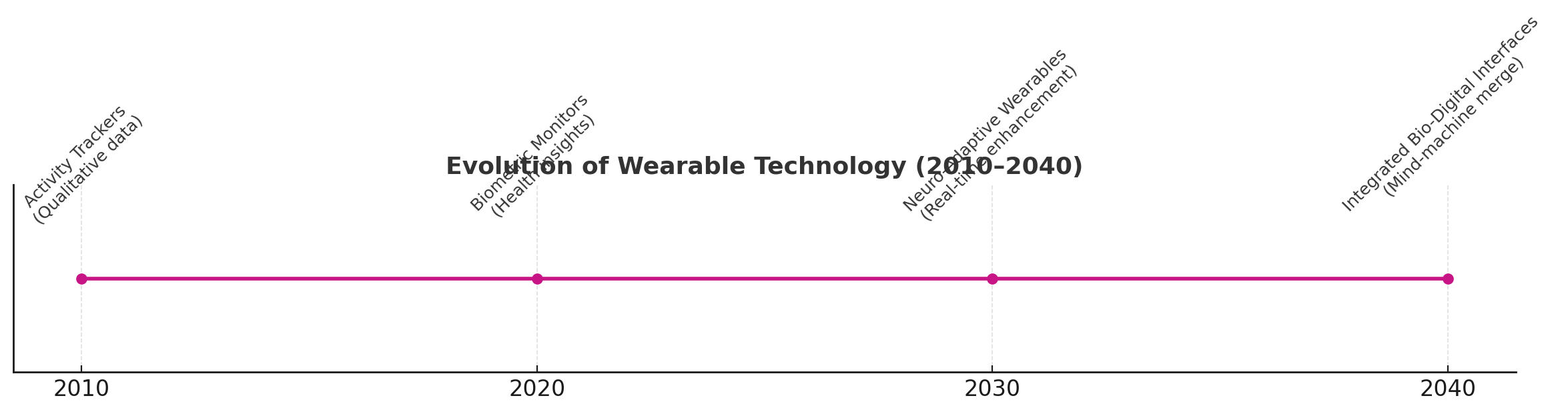
🧬 Phase 1 → Phase 3: The Evolution of Wearables

Wearable technology is evolving through three major stages:

  1. Quantify – Tracking external activity (steps, heart rate)

  2. Analyze – Interpreting internal signals (sleep, stress, oxygen)

  3. Enhance – Intervening in real time (neural input, drug delivery, emotional AI)
🔼 What’s Coming Next?

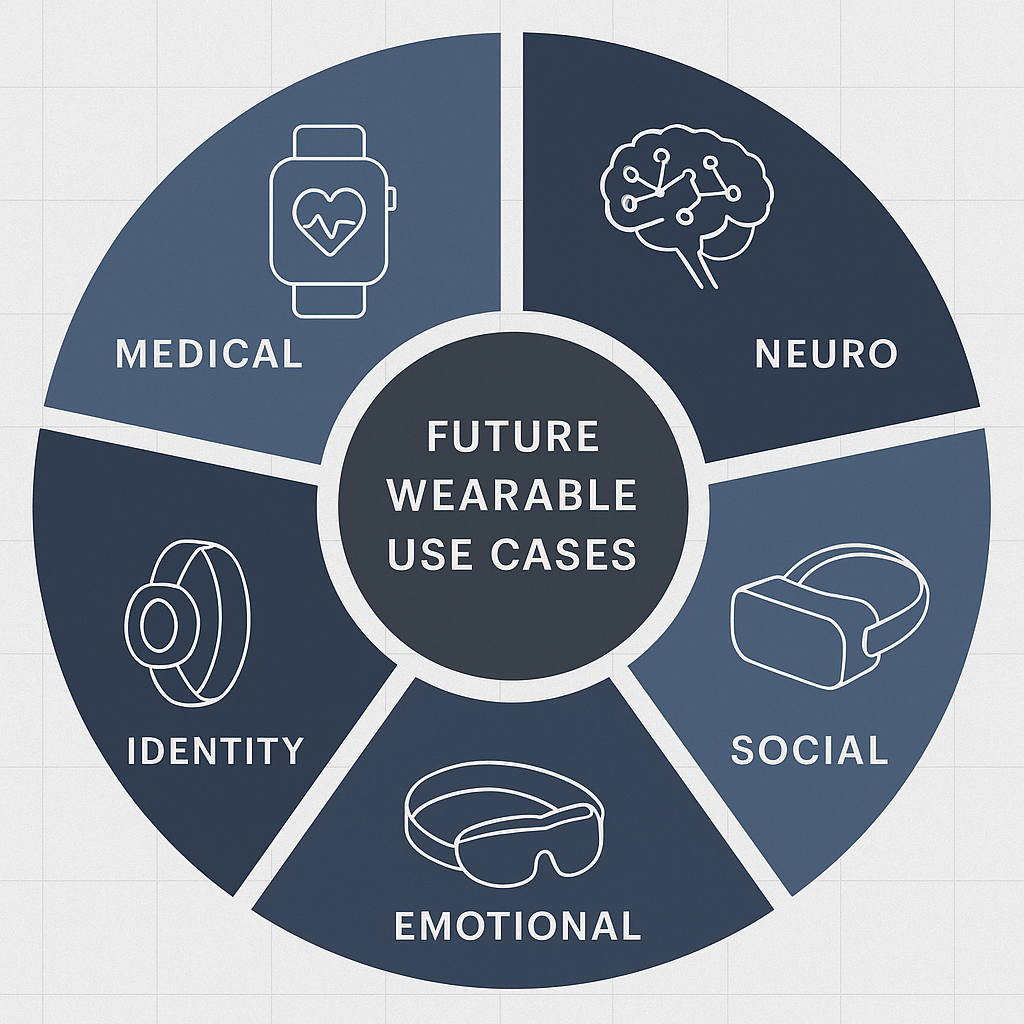
🧠 Brain-Machine Interfaces (BMIs)

Companies like Neuralink and Synchron are building devices that connect directly to the brain. Applications include:

  • Assisting paralyzed patients

  • Enhancing memory or attention

  • Controlling machines by thought

This marks the shift from monitoring to intervening and augmenting.

đŸ©ș Medical-Grade Wearables

Wearables are moving from wellness gadgets to regulated medical tools:

  • Smart tattoos for continuous glucose monitoring

  • Skin patches for drug delivery

  • AI-enhanced ECGs that predict cardiac events

Hospitals may soon rely on your own wearable data more than in-clinic tests.

🧘 Emotion-Sensing and Mental Health

Next-gen wearables will track mood, stress, and attention using:

  • Skin conductance sensors

  • Heart-rate variability

  • Facial micro-expressions (in AR glasses)

They’ll nudge users toward healthier mental states—or, in commercial hands, optimize ad timing.

⚖ Ethical Frontiers: When the Body Becomes a Platform

With this intimacy comes profound risk:

  • Privacy: Your biometric data could be sold or hacked.

  • Dependence: Overreliance on wearables may reduce bodily awareness.

  • Consent: Children and vulnerable populations may be “tracked by default.”

  • Equity: Will neuro-enhancement be available only to the wealthy?

Smart regulation and design ethics must evolve alongside the technology.
đŸ§Ÿ Conclusion: From Devices to Digital Organs

The future of wearables isn’t about gadgets—it’s about integration. As devices become smaller, smarter, and more embedded, they will evolve from external accessories into intimate interfaces between biology and technology.

But with great proximity comes great responsibility. The choices we make today—about standards, safeguards, and access—will shape not just what wearables can do, but what kind of human-machine relationship we ultimately want.

Latest Articles

Energy of Tomorrow: From Fusion to Solar Paint

Our planet is in the midst of a historic energy transformation. As the climate crisis intensifies and fossil fuel reserves dwindle, humanity faces a dual imperative: we must dramatically cut emissions while meeting the soaring energy demands of a growing, electrified world. The future of energy can no longer rely on incremental improvements—it requires bold reinvention. Enter: next-generation energy technologies. From the controlled chaos of nuclear fusion to the spray-on simplicity of solar paint, researchers and startups alike are chasing breakthroughs that once belonged to science fiction. These technologies promise not just cleaner energy, but a shift in how, where, and by whom energy is produced. This isn’t just about fuel—it’s about rethinking the structure of civilization itself.

Future Technologies

Read » 0

The Role of Nanotechnology in Future Medicine

Imagine a future where microscopic robots swim through your bloodstream, identify cancer cells before symptoms appear, and deliver medicine precisely where it’s needed—without surgery, without side effects. This isn’t science fiction. It’s the growing promise of nanotechnology in medicine. As healthcare faces rising costs, aging populations, and a need for more personalized solutions, nanomedicine offers a powerful response. By working at the nanoscale (1 to 100 nanometers)—smaller than a red blood cell—these technologies can operate with unprecedented precision. But as with all medical revolutions, the path forward is both thrilling and ethically complex.

Future Technologies

Read » 0

How Brain-Computer Interfaces Will Change Human Interaction

Brain-computer interfaces (BCIs) are moving beyond medical laboratories and into real-world applications that could fundamentally change how humans communicate, work, and interact with technology. From restoring movement and speech in patients with paralysis to enabling hands-free control of digital systems, BCIs promise faster, more intuitive interaction than keyboards, touchscreens, or voice assistants. This article explains how brain-computer interfaces work, where they already deliver measurable results, what limits their adoption today, and how they may reshape communication, accessibility, and human–machine collaboration over the next decade.

Future Technologies

Read » 0

Smart Cities: When Tech Meets Urban Living

Imagine a city where traffic lights adjust in real-time to reduce congestion, buildings regulate their own energy use, and emergency services are dispatched before a 911 call is even made. This is not a sci-fi movie—it’s the emerging reality of smart cities, where digital infrastructure is interwoven with the physical world to improve how we live, work, and move. As urbanization accelerates and climate concerns deepen, cities are under pressure to become more efficient, resilient, and livable. Smart city technologies—ranging from IoT sensors to AI-powered analytics—promise to transform chaotic urban environments into optimized ecosystems. But they also raise questions: Who controls the data? Can cities become too automated? And will technology truly make urban life better—or just more monitored? In this article, we’ll explore what makes a city “smart,” where the technology is heading, and what this transformation means for the future of society.

Future Technologies

Read » 0

Quantum Computing Explained: What Happens After Classical Machines

Quantum computing is moving from theory into early real-world experimentation, forcing businesses, developers, and policymakers to rethink what comes after classical machines. While traditional computers are approaching physical and performance limits, quantum systems promise breakthroughs in optimization, cryptography, materials science, and artificial intelligence. This article explains how quantum computing actually works beyond simplified metaphors, where it already outperforms classical approaches, and where it still falls short. You’ll learn what industries should realistically prepare for, which problems will remain classical, and how organizations can start building quantum-ready strategies without hype or unrealistic expectations.

Future Technologies

Read » 0

The Rise of Digital Twins in Industry and Healthcare

Digital twins are rapidly transforming how industries design, operate, and improve complex systems — from factories and power grids to hospitals and individual patients. By creating continuously updated virtual replicas of physical assets and biological processes, organizations can simulate scenarios, predict failures, and optimize outcomes before real-world risks appear. This article explains how digital twins actually work in industrial and healthcare settings, where they deliver measurable ROI today, and why many implementations fail. You’ll learn practical adoption strategies, real-world use cases, and concrete steps to build digital twin systems that generate operational, clinical, and financial value.

Future Technologies

Read » 0