How Quantum Computing Will Change Everything

3 min read

1

Imagine a computer so powerful it could unravel today’s most secure encryption in seconds, model the molecular structure of a new life-saving drug in minutes, or simulate the birth of the universe with unparalleled precision. This isn’t the stuff of science fiction—it’s the promise of quantum computing, a revolutionary technology that leverages the counterintuitive rules of quantum mechanics. Unlike classical computers that process information in binary (0s and 1s), quantum computers use qubits, which can exist in multiple states simultaneously. This shift doesn’t just mean faster computing—it opens doors to fundamentally new ways of solving problems. But with that power comes profound ethical, scientific, and societal consequences.
⚛️ The Strange Science Behind the Power

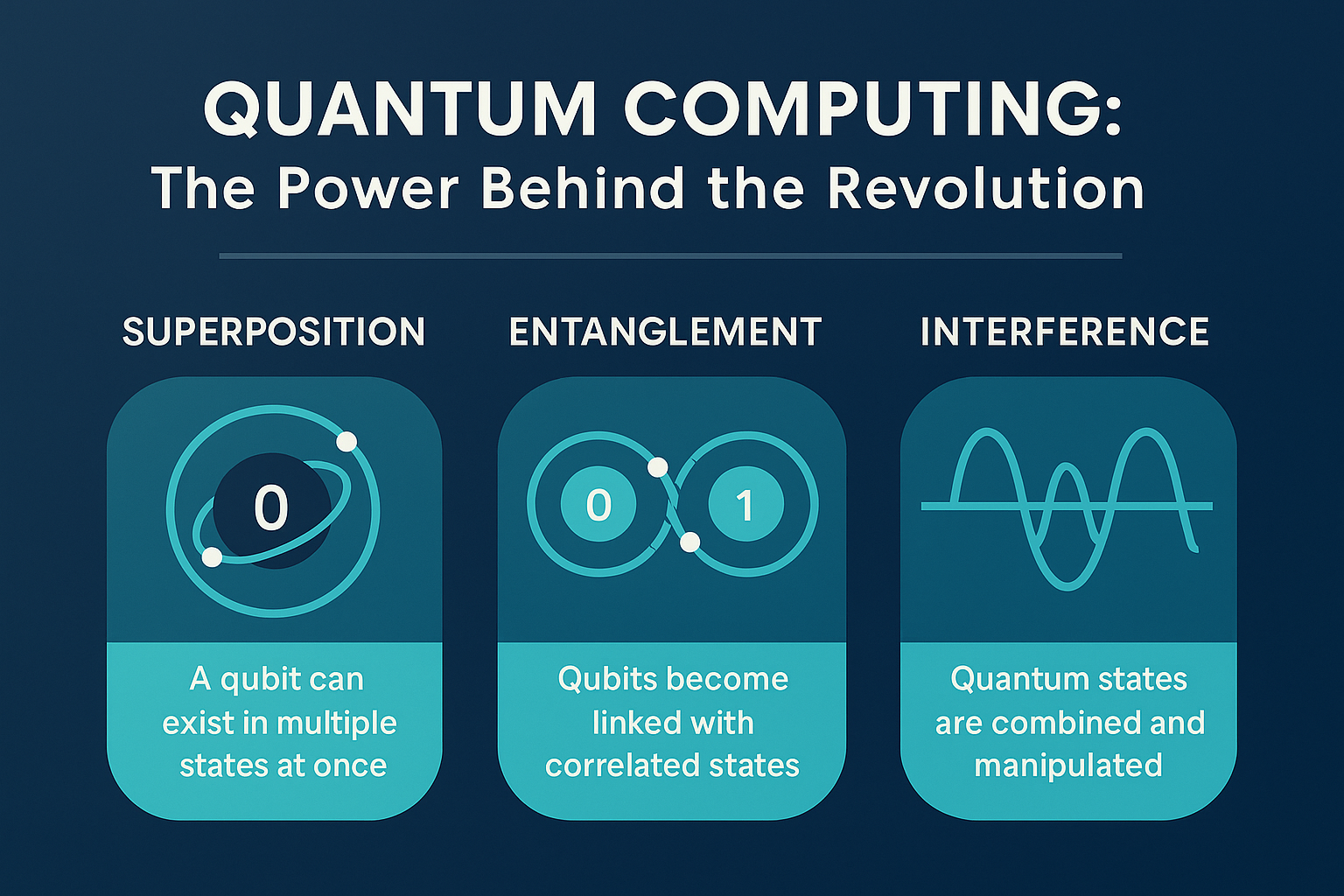
To understand quantum computing, meet its three core principles:

  • 🌀 Superposition – A qubit can be 0, 1, or both at once. This lets quantum systems explore multiple solutions simultaneously.

  • 🔗 Entanglement – Entangled qubits influence each other instantly, even across distance. This creates powerful computational correlations.

  • 🎯 Interference – Helps amplify the right answers and cancel the wrong ones.

Together, these principles allow quantum machines to solve certain problems that would take classical computers millions of years.

🚨 A Revolution in Waiting

Quantum computing isn’t just fast—it’s disruptive.

🔓 Cybersecurity Under Threat

Most of today’s digital encryption relies on math that’s too complex for classical machines to break. But quantum algorithms like Shor’s could change that overnight.

  • “Harvest now, decrypt later” is already in play—some actors are stockpiling encrypted data to crack it in the future.

  • Governments and companies are racing to develop quantum-resistant encryption.

🧬 Transforming Medicine and Materials

Quantum systems can natively model quantum chemistry, unlocking:

  • New drug development pipelines

  • Superconductors that work at room temperature

  • Catalysts for cleaner industrial production

📦 Optimizing the Unthinkable

Quantum computing will revolutionize industries based on optimization:

  • 🚚 Logistics & traffic flow (Volkswagen already tested this!)

  • 💹 Finance & portfolio management

  • 🌦️ Weather forecasting

  • 🧬 Personalized medicine

🏁 Who’s Leading the Quantum Race?

It’s a global sprint:

  • Google, IBM, Microsoft are leading private-sector innovation with different architectures (superconducting qubits, trapped ions, etc.).

  • China, the U.S., the EU and others are investing billions into national quantum programs.

This is more than a tech race—it’s a battle over future cybersecurity, intelligence, and economic power.

🧊 Why Quantum Isn’t Ready—Yet

We’re in the NISQ (Noisy Intermediate-Scale Quantum) era:

  • Qubits are fragile and prone to noise.

  • Systems require ultra-cold environments colder than space.

  • Quantum decoherence limits how long calculations can last.

  • Error correction is a huge scientific hurdle still being solved.

👉 Experts estimate 5–15 years until fault-tolerant, scalable quantum computers arrive.

⚖️ Quantum Power, Ethical Responsibility

With quantum’s arrival, tough questions follow:

  • Who controls quantum decryption power?

  • How do we prevent monopolies on quantum tech?

  • What happens when quantum computing meets AI? 

Like nuclear tech, quantum is dual-use—capable of curing disease or enabling surveillance and warfare. Its development must be guided by ethics, law, and inclusion.

🛠️ Preparing for the Quantum Future

We can’t wait passively—we must shape it.

Educators must teach quantum literacy.
Governments must regulate development and security.
Technologists must build ethical, inclusive systems.
Citizens must stay informed and demand accountability.

🚀 Beyond Imagination

Quantum computing isn’t just another faster chip. It redefines what’s even possible to solve. With it, we’ll simulate nature, predict complex systems, and reimagine industries.

But as with any transformative force, the outcome won’t be determined by the machines alone—it will depend on the choices we make.

We’re no longer asking if quantum computing will change the world—only how, and for whom.

 

Latest Articles

5G, 6G, and Beyond: What’s Next in Connectivity?

Our world is bound together by a web of signals. Every video call, online transaction, and AI prompt relies on a complex communications infrastructure that’s evolving faster than ever. From 2G voice calls to 5G smart cities, connectivity isn’t just improving speed—it’s reshaping how we live, work, and sense the world. With 5G rolling out globally, attention is already turning to 6G—a network that promises not just bandwidth, but awareness. And what comes after may blur the boundaries between communication, intelligence, and environment. Understanding what’s next in connectivity is essential—not just for tech enthusiasts, but for anyone navigating a future where latency, spectrum, and sensing are as vital as electricity.

Future Technologies

Read » 0

Smart Cities: When Tech Meets Urban Living

Imagine a city where traffic lights adjust in real-time to reduce congestion, buildings regulate their own energy use, and emergency services are dispatched before a 911 call is even made. This is not a sci-fi movie—it’s the emerging reality of smart cities, where digital infrastructure is interwoven with the physical world to improve how we live, work, and move. As urbanization accelerates and climate concerns deepen, cities are under pressure to become more efficient, resilient, and livable. Smart city technologies—ranging from IoT sensors to AI-powered analytics—promise to transform chaotic urban environments into optimized ecosystems. But they also raise questions: Who controls the data? Can cities become too automated? And will technology truly make urban life better—or just more monitored? In this article, we’ll explore what makes a city “smart,” where the technology is heading, and what this transformation means for the future of society.

Future Technologies

Read » 0

The Rise of Digital Twins in Industry and Healthcare

Digital twins are rapidly transforming how industries design, operate, and improve complex systems — from factories and power grids to hospitals and individual patients. By creating continuously updated virtual replicas of physical assets and biological processes, organizations can simulate scenarios, predict failures, and optimize outcomes before real-world risks appear. This article explains how digital twins actually work in industrial and healthcare settings, where they deliver measurable ROI today, and why many implementations fail. You’ll learn practical adoption strategies, real-world use cases, and concrete steps to build digital twin systems that generate operational, clinical, and financial value.

Future Technologies

Read » 0

The Future of Wearable Tech: Beyond Fitness Trackers

When wearable technology first gained mainstream traction, it came in the form of simple fitness bands counting our steps and calories. Fast-forward a decade, and wearables are evolving into powerful personal ecosystems—blending health monitoring, immersive computing, emotional sensing, and even digital identity. The future of wearable tech goes far beyond counting steps; it’s reshaping how we interact with our bodies, environments, and society itself. From smart contact lenses that monitor blood glucose to brain-computer interfaces that allow you to control devices with thought, wearables are no longer accessories. They are becoming extensions of the self—part digital, part biological, and entirely transformative. But as these technologies grow more intimate and powerful, they raise new questions about data, privacy, ethics, and dependence. This article explores the next wave of wearable innovation, the forces driving it, and what lies beyond the wrist.

Future Technologies

Read » 0

Quantum Computing Explained: What Happens After Classical Machines

Quantum computing is moving from theory into early real-world experimentation, forcing businesses, developers, and policymakers to rethink what comes after classical machines. While traditional computers are approaching physical and performance limits, quantum systems promise breakthroughs in optimization, cryptography, materials science, and artificial intelligence. This article explains how quantum computing actually works beyond simplified metaphors, where it already outperforms classical approaches, and where it still falls short. You’ll learn what industries should realistically prepare for, which problems will remain classical, and how organizations can start building quantum-ready strategies without hype or unrealistic expectations.

Future Technologies

Read » 1

Energy of Tomorrow: From Fusion to Solar Paint

Our planet is in the midst of a historic energy transformation. As the climate crisis intensifies and fossil fuel reserves dwindle, humanity faces a dual imperative: we must dramatically cut emissions while meeting the soaring energy demands of a growing, electrified world. The future of energy can no longer rely on incremental improvements—it requires bold reinvention. Enter: next-generation energy technologies. From the controlled chaos of nuclear fusion to the spray-on simplicity of solar paint, researchers and startups alike are chasing breakthroughs that once belonged to science fiction. These technologies promise not just cleaner energy, but a shift in how, where, and by whom energy is produced. This isn’t just about fuel—it’s about rethinking the structure of civilization itself.

Future Technologies

Read » 1