Why Soft Skills Will Matter More Than Ever in 2030 🤖💡
As AI and automation handle increasingly complex tasks—from managing supply chains to analyzing vast datasets—human workers will need to focus on areas where machines fall short. Soft skills—such as emotional intelligence, adaptability, creativity, and critical thinking—are those very areas. These abilities enable humans to navigate uncertainty, solve unique problems, and communicate effectively, tasks that require deep understanding, nuance, and empathy. The more that machines take over the "how," the more essential the "why" will become. And that’s where soft skills come in.
Moreover, the nature of work will be fundamentally reshaped. Remote work, flexible schedules, and cross-functional teams will be the norm, requiring new ways of collaboration. The ability to connect with others virtually, manage diverse teams, and motivate peers will all be skills in high demand.
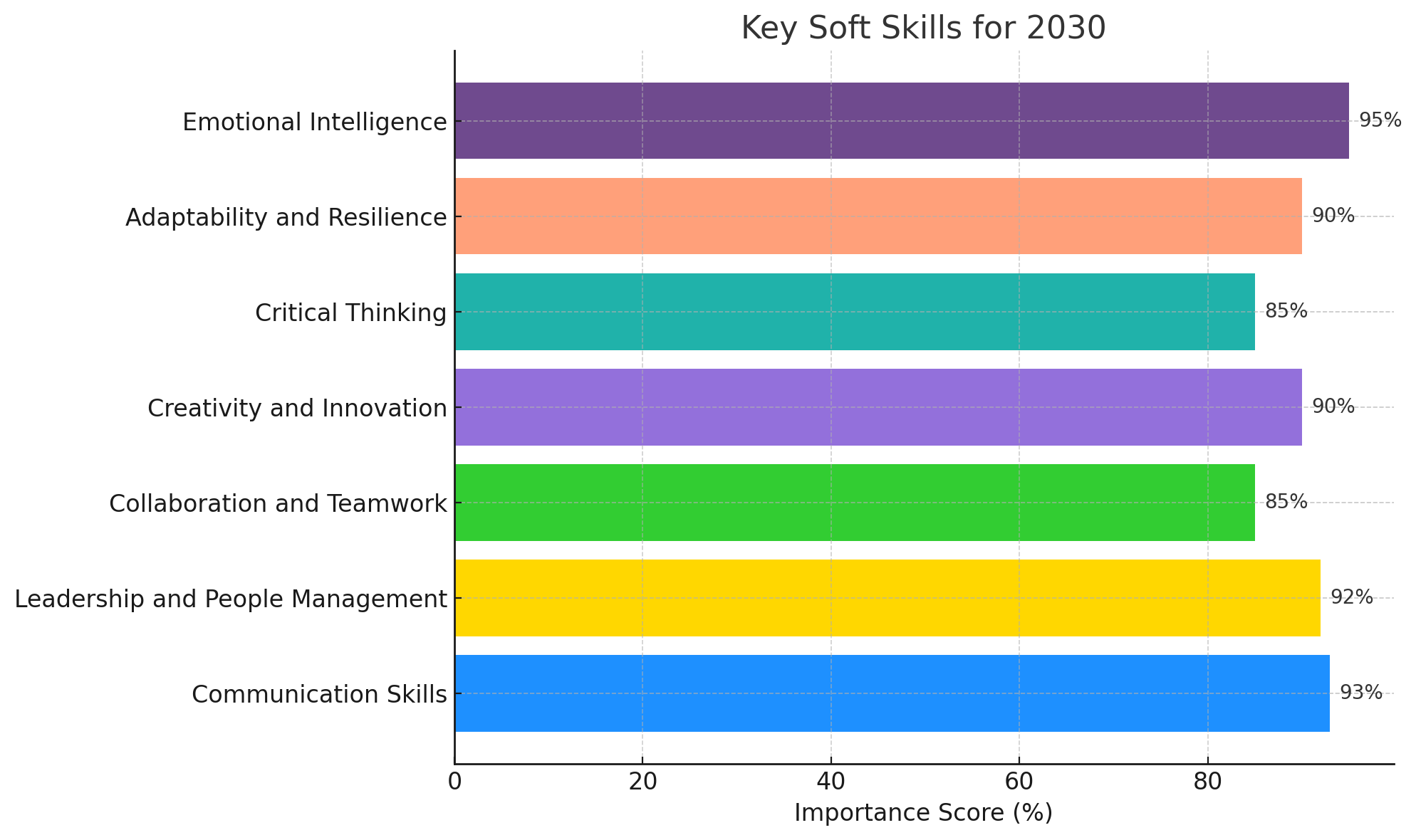
Key Soft Skills for 2030 🌟
1. Emotional Intelligence (EQ) 💖
Emotional intelligence—the ability to understand and manage your own emotions while empathizing with others—will be indispensable in a world where human interaction remains vital. Leaders and team members who can navigate complex social dynamics, build strong relationships, and manage emotions effectively will thrive in leadership roles and collaborative settings.
Example: A project manager with high emotional intelligence can motivate a remote team, diffuse conflicts, and ensure clear, empathetic communication in virtual settings.
2. Adaptability and Resilience 🔄
The pace of change will only accelerate as industries continue to evolve. Professionals who can pivot, adapt to new environments, and stay resilient in the face of challenges will be the ones who succeed. This skill will be essential not just for individuals, but for teams and entire organizations.
Example: During a company-wide digital transformation, employees who embrace the change and continue to innovate rather than resist it will become key players in the organization’s future.
3. Critical Thinking and Problem-Solving 🧠
AI and automation can handle repetitive tasks and analyze data, but they cannot make judgments based on context or nuance. Critical thinking—analyzing information, questioning assumptions, and solving complex problems—will remain uniquely human. These skills will be crucial for leadership, decision-making, and innovation.
Example: In healthcare, doctors will increasingly rely on AI for diagnosis, but the decision to proceed with a specific treatment or consider alternative therapies will still require the critical thinking and intuition of experienced medical professionals.
4. Creativity and Innovation 🎨
AI is designed to process patterns and optimize efficiency, but the ability to think outside the box, dream up new solutions, and innovate will still be a distinctly human skill. Creativity will be essential for tackling unprecedented challenges and creating products or services that resonate emotionally with consumers.
Example: An advertising executive using AI-driven data to optimize campaigns can still leverage creativity to craft compelling narratives or emotional connections that resonate with a diverse audience.
5. Collaboration and Teamwork 🤝
As organizations become more decentralized and teams more global, the ability to work well with others—across cultures, time zones, and disciplines—will be more valuable than ever. The skills required to collaborate effectively, share ideas, and resolve conflicts in diverse teams will be a major differentiator.
Example: In a cross-functional team developing a new software product, the ability to communicate effectively, listen to diverse perspectives, and integrate ideas from design, marketing, and engineering will be crucial to success.
6. Leadership and People Management 🏅
AI may be able to optimize tasks and perform predictive analytics, but leadership will always require a human touch. In 2030, strong leadership will depend on motivating others, fostering a positive culture, and guiding teams through ambiguity.
Example: A team leader managing a hybrid workforce will need to balance remote and in-office dynamics, ensuring team cohesion, well-being, and productivity despite the challenges posed by location differences.
7. Communication Skills 🗣
In a world where remote and digital communication will dominate, clear and effective communication—both written and verbal—will become even more critical. The ability to convey ideas simply, persuasively, and with empathy is essential in managing remote teams, leading meetings, or engaging clients.
Example: A consultant presenting a new business strategy to a client in a virtual meeting will need to distill complex information into clear, digestible points and ensure their message is tailored to the audience’s needs.
Professions Shaping the Future Workforce 🔮
The professions that will thrive in 2030 won’t just be defined by technical expertise; they’ll be shaped by those who can harness soft skills in an increasingly tech-driven world. Here are some examples of careers that will place a premium on these abilities:
-
AI-Enhanced Healthcare Professionals: Doctors, nurses, and therapists who can interpret AI-driven data while maintaining empathy and critical judgment.
-
Remote Collaboration Specialists: Experts in facilitating effective communication and teamwork in virtual or hybrid settings.
-
Sustainability Leaders: Professionals who combine technical knowledge of renewable energy with the emotional intelligence needed to advocate for and implement sustainable practices across industries.
-
Human-AI Interaction Designers: Designers who understand both the technical aspects of AI and the human side of its implementation, ensuring seamless and ethical collaboration between machines and humans.
-
Cultural Consultants: As globalization and remote work blur cultural boundaries, individuals with cross-cultural communication skills will be essential to ensure smooth international collaboration.
Preparing for the Future: Skills for 2030 🔧
While technical knowledge will remain important, it is clear that soft skills will define the most successful professionals in 2030. To prepare, focus on these actionable steps:
-
Develop Emotional Intelligence: Practice self-awareness, empathy, and active listening in both personal and professional contexts.
-
Cultivate Adaptability: Take on new challenges, embrace change, and focus on continuous learning to develop resilience.
-
Sharpen Critical Thinking: Engage in problem-solving exercises, read widely, and challenge your own assumptions.
-
Nurture Creativity: Explore new hobbies, brainstorm regularly, and push yourself to think outside the box.
-
Practice Collaboration: Seek out diverse teams, work on communication skills, and foster relationships that value different perspectives.
Conclusion: The Human Edge in a Tech-Driven World 🌐
In 2030, AI and automation will undoubtedly transform industries, but the most successful professionals will be those who can integrate technology with the uniquely human abilities of empathy, creativity, and critical thinking. Soft skills will remain the key differentiator, ensuring that we continue to drive innovation, build strong relationships, and lead in an increasingly digital world. By developing these essential skills today, we can future-proof our careers and stay ahead in a world that’s driven by both technology and humanity.