The Shift: From Automation to Collaboration
Traditionally, automation aimed to replace human labor in routine, repetitive tasks—think assembly lines or payroll processing. But modern AI enables augmentation: systems that work alongside people, enhancing their capabilities rather than rendering them obsolete.
🔄 Automation vs. Collaboration:
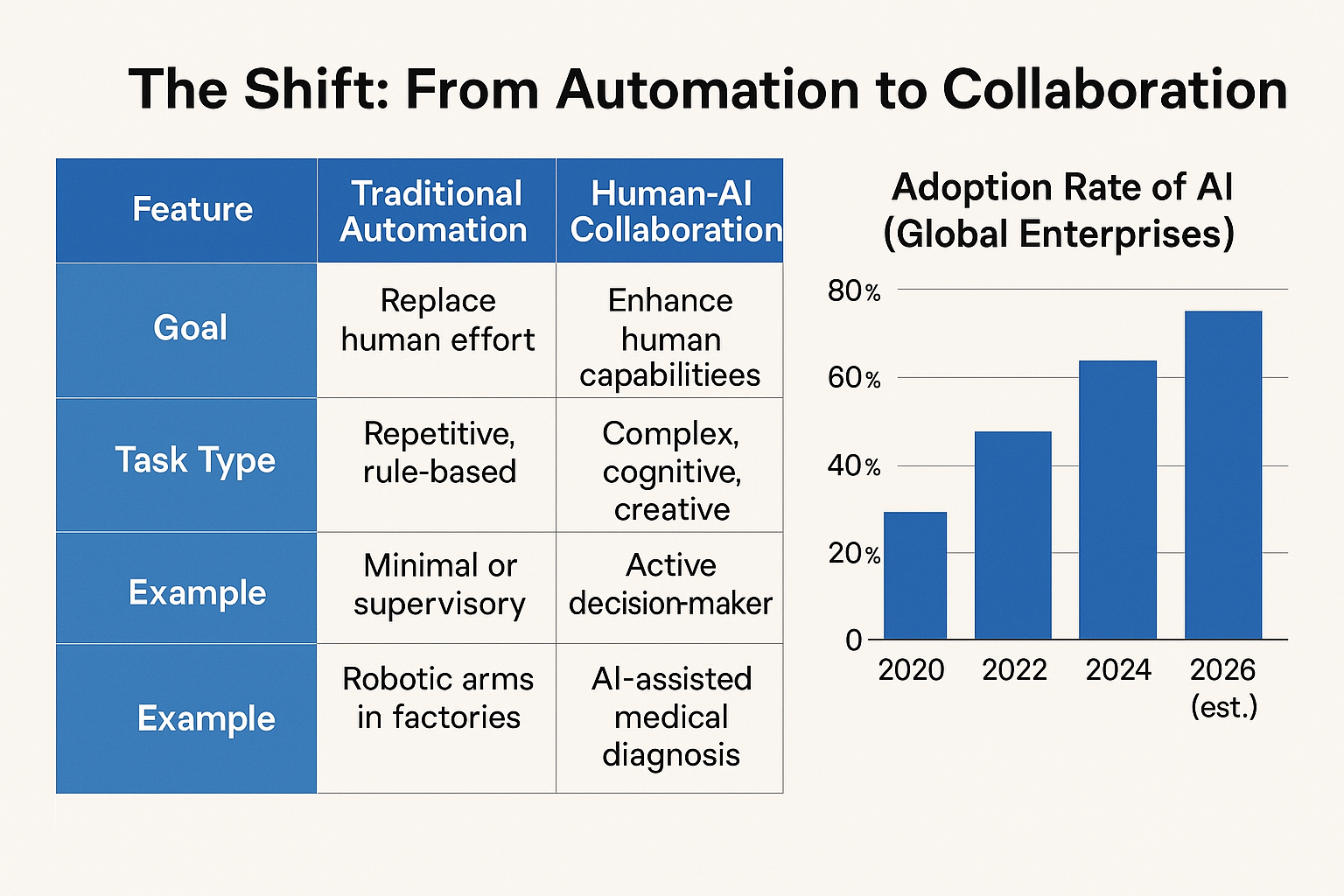
| Feature | Traditional Automation | Human-AI Collaboration |
|----------------------|-----------------------------|-------------------------------|
| Goal | Replace human effort | Enhance human capabilities |
| Task Type | Repetitive, rule-based | Complex, cognitive, creative |
| Human Role | Minimal or supervisory | Active decision-maker |
| Example | Robotic arms in factories | AI-assisted medical diagnosis |
Key Sectors Being Transformed
🏥 Healthcare
-
AI-assisted diagnosis: Tools like Google’s DeepMind or IBM Watson detect anomalies in medical imaging faster than humans.
-
Workflow automation: AI handles medical transcription, appointment scheduling, and insurance processing.
-
Example: PathAI helps pathologists detect cancer with higher accuracy by highlighting suspicious regions in biopsy slides.
📊 Finance
-
Fraud detection: Machine learning models monitor billions of transactions in real time.
-
Robo-advisors: AI-powered platforms like Betterment or Wealthfront provide investment strategies based on user goals.
-
Example: JPMorgan’s COiN analyzes legal documents in seconds—a task that used to take lawyers 360,000 hours annually.
🎨 Creative Industries
-
AI in music and design: Tools like DALL·E, Midjourney, and AIVA compose music, create visuals, and generate storyboards.
-
Human-AI symbiosis: Designers use AI to explore variations quickly, then add human nuance and emotion.
-
Example: Filmmakers use AI to previsualize scenes before committing to full production.
🏭 Manufacturing and Logistics
-
Predictive maintenance: AI forecasts equipment failure, reducing downtime.
-
Smart warehouses: Robots coordinate in real time, managed by AI logistics platforms.
-
Example: Amazon’s Kiva robots work alongside human pickers, increasing efficiency without full human replacement.
Adoption Trends: The AI Climb
Adoption Rate of AI (Global Enterprises) 2020 — 25% 2022 — 35% 2024 — 55% 2026 (est.) — 70%
Source: McKinsey, Gartner, PwC trend reports.
AI adoption is rising sharply, especially in data-heavy, decision-rich environments. By 2026, over 70% of enterprises are expected to embed some form of collaborative AI.
The Anatomy of Human-AI Synergy
For AI to effectively augment humans, it must align with human intent, context, and ethics. Here's what this synergy typically includes:
🔧 Roles in Human-AI Collaboration:
-
The Human: Sets goals, applies judgment, ensures ethics, interprets AI outputs
-
The AI: Processes massive data, identifies patterns, predicts outcomes, suggests actions
[Human sets goal] → [AI analyzes data] → [Human reviews AI suggestion] → [Joint decision or action] → [Human gives feedback] → [AI improves]
This feedback loop is key. Without human oversight, AI can amplify bias or make opaque decisions. With oversight, it becomes a powerful tool for learning and problem-solving.
Challenges Ahead
Despite its promise, human-AI collaboration is not without risks:
-
Bias and fairness: AI systems trained on biased data can perpetuate inequality.
-
Explainability: Many advanced models (e.g., deep learning) are "black boxes" even to their creators.
-
Over-reliance: Blind trust in AI can lead to disastrous outcomes (e.g., autopilot errors in aviation).
-
Job displacement: Although collaboration is the goal, some roles will become obsolete.
Preparing for the Human-AI Era
What must societies do to thrive in an AI-augmented world?
-
Invest in AI literacy: Not everyone must code, but understanding how AI works is the new digital literacy.
-
Redesign education: Emphasize creativity, ethics, critical thinking—skills AI can’t replicate.
-
Create hybrid jobs: Encourage new roles like "AI ethicist", "prompt engineer", or "human-in-the-loop coordinator".
-
Update laws and ethics: Establish clear norms around AI responsibility, privacy, and rights.
Final Thoughts
AI is not humanity’s rival—it is our mirror. It reflects our logic, our blind spots, and our brilliance. The future lies not in fighting the machine or yielding to it, but in designing systems where each complements the other. Human intuition and ethical reasoning, paired with AI’s data mastery and speed, can unlock solutions to problems previously beyond our grasp.
We are not facing a world run by AI—we are building a world with AI. The sooner we learn to collaborate wisely, the greater our collective potential becomes.