Education has always been slow to change. Classrooms today still resemble those of a century ago—rows of desks, chalkboards (or their digital twins), a one-size-fits-all curriculum. But beneath the surface, a quiet revolution is happening. Fueled by technology, necessity, and new ideas about what learning should be, EdTech startups are rewriting the rules of how we acquire knowledge and skills.
The COVID-19 pandemic didn’t invent online education—it accelerated it. Now, from Lagos to London, from primary schools to professional upskilling, digital platforms are empowering students to learn on their own terms. This shift isn't just about moving content online; it's about transforming access, personalization, equity, and even the business model of education.
In this article, we’ll explore how a new wave of EdTech innovators is shaping the future of learning, and why the classroom of tomorrow might live in your pocket, in the cloud—or even in the metaverse.
🚀 What Is EdTech, Really?
EdTech (Education Technology) is more than Zoom lectures and YouTube tutorials. It’s a growing ecosystem of tools that leverage:
-
AI and adaptive learning
-
Gamification and simulations
-
Blockchain for credentialing
-
AR/VR for immersive learning
-
Peer-to-peer and cohort-based learning
-
Data analytics for student performance
EdTech is not replacing teachers—it’s augmenting them, and in some cases, reshaping the very idea of what a teacher is.
🌍 Global Startups Reimagining Education
Here are five standout EdTech startups that are transforming how people learn—and why they matter:
1. Duolingo (USA)
Focus: Language learning with gamified micro-lessons
Why it matters: Duolingo makes language acquisition fun, addictive, and global, with over 500 million users learning 40+ languages—many in underserved regions.
2. Uolo (India)
Focus: Digital infrastructure for K-12 schools
Why it matters: Uolo helps over 7,000 low-cost schools digitize operations and deliver remote content, closing gaps in access for millions of students in India’s Tier 2 and 3 cities.
3. Labster (Denmark)
Focus: Virtual science labs in 3D environments
Why it matters: Labster allows students to conduct realistic biology, chemistry, and physics experiments in VR—making STEM education more accessible and scalable.
4. GoStudent (Austria)
Focus: 1-on-1 tutoring via live video
Why it matters: The platform connects students with vetted tutors in real time, using AI to match learners with the best-fit experts—scaling personalized instruction across Europe.
5. Mindvalley (Malaysia/Global)
Focus: Transformational learning for adults
Why it matters: Mindvalley mixes personal development, mental fitness, and career skills, breaking down traditional barriers between "education" and "life coaching."
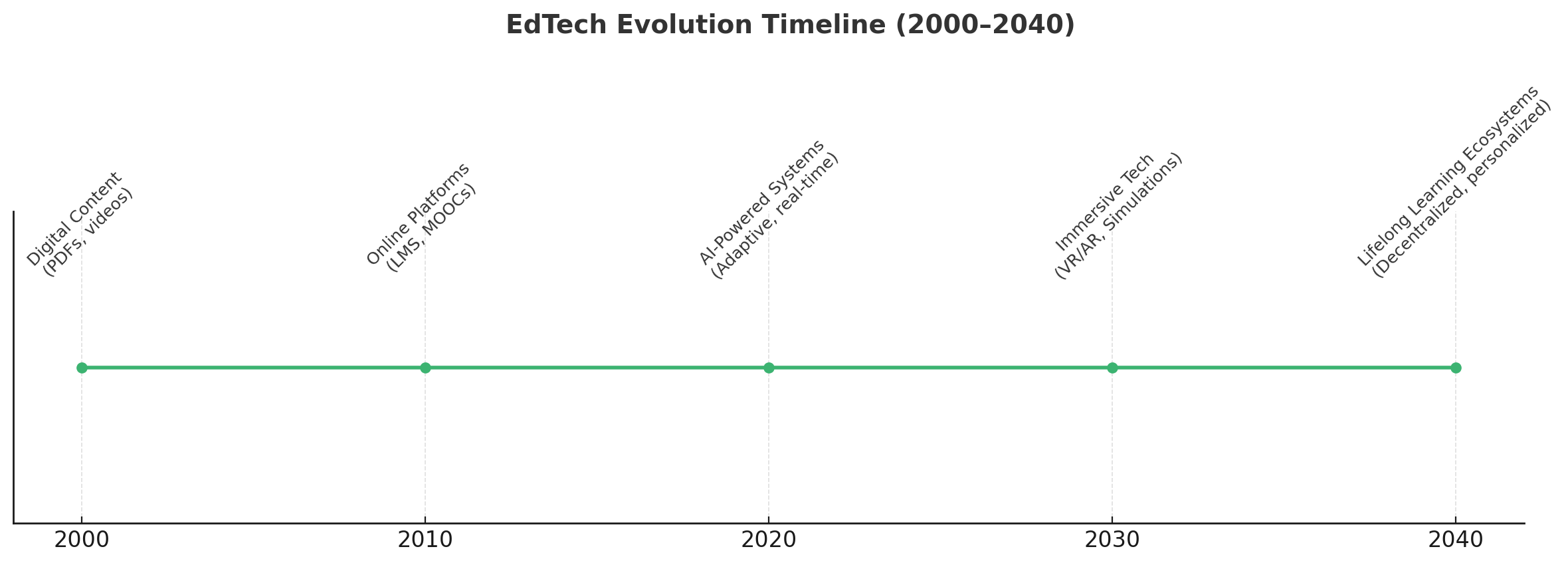
📊 The Evolution of EdTech: From Tools to Ecosystems
Let’s map the evolution of EdTech across three decades:
🔮 What Comes Next?
EdTech is moving toward lifelong learning ecosystems, where skills are modular, credentials are digital, and learning is on-demand, decentralized, and hyper-personalized.
Key future shifts include:
-
AI mentors replacing static curricula
-
Skills-based hiring replacing degree-based hiring
-
Blockchain credentials validating learning anywhere
-
Edutainment—where learning blends with media, games, and AR
🧾 Conclusion: Why Startups Matter
Startups are uniquely positioned to challenge outdated systems. They move faster than institutions, think globally by default, and are shaped by feedback—not bureaucracy. While not every platform will succeed, the best ones reimagine learning as a flexible, lifelong, and empowering journey.
In the end, the startups transforming education are doing more than digitizing lessons—they’re reinventing the relationship between knowledge, technology, and human potential.